
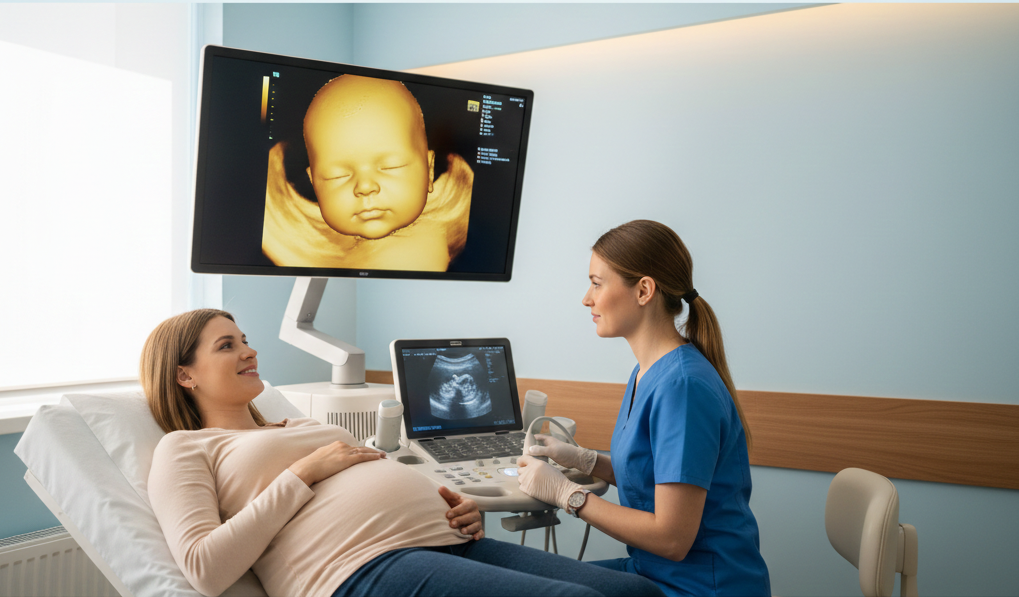
In the journey of pregnancy, your second trimester—often called the “golden period”—holds a pivotal moment that goes beyond just a routine check-up. The 3D/4D Sonography appointment, usually scheduled between 18 and 24 weeks, is the bridge between clinical data and emotional connection.
At Shivansh Women’s Hospital, we consider this more than a photo op; it is a critical diagnostic window. Here is why this date is the most important one on your calendar.
1. The Anomaly Scan: A Detailed Health Audit
While 2D scans provide a flat, “slice-like” view of the baby, 3D and 4D technology allow doctors to see the external and internal structures with incredible depth. This is the primary time we perform a “Level II” or Anomaly Scan.
- Organ Development: We check the four chambers of the heart, the kidneys, the stomach, and the brain structure.
- Cleft Lip/Palate: 3D imaging is the gold standard for spotting external physical markers like a cleft lip that 2D scans might miss.
- Spinal Integrity: We ensure the spine is closed and properly aligned.
- Real Problem: Some parents think this is just for “pretty pictures.” Example: Imagine looking at a house through a blueprint (2D) versus walking through the front door (3D). The walkthrough tells you if the walls are actually straight.
2. Real-Time Behavioral Observation (4D)
The “4th dimension” in 4D sonography is time. This means we are watching a live video of your baby. This isn’t just for fun; it tells us a lot about the baby’s neurological health.
- Reflexes: We watch the baby swallow, yawn, and suck their thumb.
- Muscle Tone: Active movement of the limbs indicates a healthy, developing nervous system.
- Comfort Levels: We can see how the baby reacts to sound or movement.
- Real Problem: Worrying about “quiet” days. Example: If you haven’t felt a kick in an hour, seeing the baby move in real-time on the 4D monitor provides instant clinical and emotional relief.
3. Bonding and Maternal Mental Health
The psychological impact of seeing your baby’s face—recognizing “Dad’s nose” or “Mom’s chin”—cannot be overstated. For many parents, this is the moment the pregnancy feels “real.”
- Paternal Connection: It helps partners who aren’t physically carrying the baby to feel a deep, visceral connection to the child.
- Anxiety Reduction: Visualizing the baby as a human being rather than a “medical concept” significantly lowers maternal stress hormones.
- Preparation: Seeing the baby’s features helps parents begin the transition into their roles as caregivers.
- Real Problem: Feeling “disconnected” from the pregnancy. Example: It’s the difference between reading a letter from a friend and seeing them on a high-definition video call; the emotional weight is entirely different.
4. Assessing the “Environment” (Placenta & Fluid)
This scan isn’t just about the baby; it’s about the support system. We use this appointment to check the “house” the baby is living in.
- Placental Position: We check if the placenta is too low (Placenta Previa), which could affect delivery plans.
- Amniotic Fluid Levels: We ensure there is enough fluid for the baby to move and for the lungs to develop.
- Uterine Blood Flow: Using Doppler (often paired with these scans), we check if the baby is getting enough nutrients and oxygen.
- Real Problem: Sudden complications in the third trimester often have roots in the second. Example: Checking the “fuel gauge” mid-trip ensures you don’t run out of gas before you reach the destination.
5. Precise Growth Tracking
By the second trimester, we can get very accurate measurements of the baby’s head circumference, abdominal girth, and femur length to plot a growth curve.
- Growth Consistency: We compare these numbers to your first-trimester scans to ensure the baby is growing at the right pace.
- Due Date Confirmation: If there was any doubt about the conception date, this scan provides a highly reliable “Estimated Date of Delivery” (EDD).
- Weight Estimation: We can get a fairly accurate estimate of the baby’s current weight.
- Real Problem: Small-for-gestational-age (SGA) concerns. Example: If the baby is measuring smaller than expected, we can intervene early with specialized nutrition or closer monitoring at Shivansh Hospital.
6. Planning for the Third Trimester
The results of your 3D/4D scan dictate the roadmap for the rest of your pregnancy. It tells us if we need to prepare for a routine delivery or if specialized care is required.
- Frequency of Visits: If everything is perfect, you can continue with standard monthly check-ups.
- Specialist Referrals: If a minor issue is found, it gives us months to consult with pediatric specialists before the birth.
- Delivery Mode: Understanding the baby’s position and placental health helps Dr. Saurabh Suthar discuss birth options (like painless delivery) with you.
- Real Problem: Last-minute surprises during labor. Example: Knowing the baby’s position now is like checking the weather before a long drive; you can pack the right gear and choose the best route.