
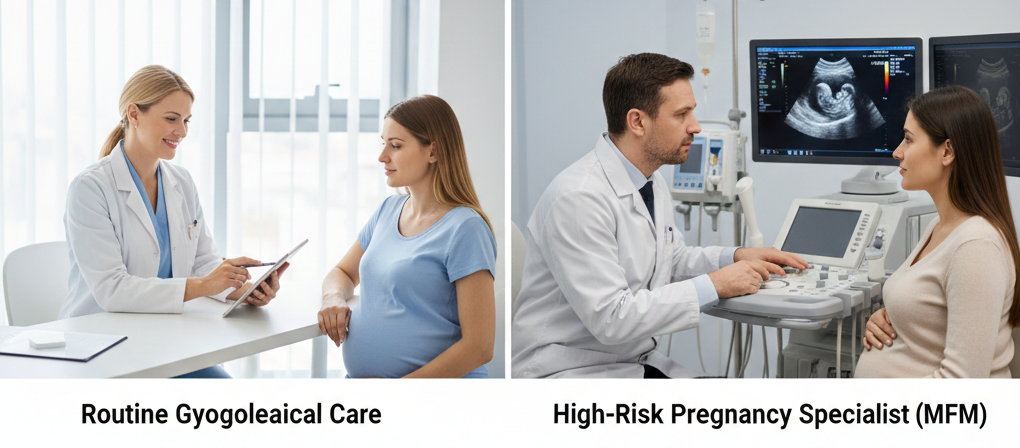
At Shivansh Women’s Hospital and Cosmetic Skin Clinic in Nikol, Ahmedabad, we understand that every pregnancy is a unique journey, but some paths require a more specialized map.
While a general gynecologist is the primary guardian of women’s reproductive health, a high-risk pregnancy specialist—often referred to as a Maternal-Fetal Medicine (MFM) expert—focuses specifically on the “what ifs.”
Led by Dr. Saurabh Suthar, our facility is designed to bridge the gap between routine prenatal care and the intensive management required for complex cases.
At Shivansh, we provide the advanced diagnostic tools, such as high-resolution 3D/4D sonography and specialized Doppler studies, that allow us to manage complications that a standard clinic might not be equipped to handle.
1. Depth of Specialized Training
A regular gynecologist is trained to manage the entire spectrum of women’s health, from puberty to menopause. However, a high-risk specialist undergoes years of additional training focused exclusively on the complications of pregnancy, involving both the mother’s health and the baby’s development in utero.
The Focus of Expertise
- Complex Pathologies: They manage pre-existing conditions like heart disease, kidney failure, or autoimmune disorders during pregnancy.
- Advanced Diagnostics: Specialists are trained to interpret complex scans that look for subtle fetal abnormalities.
- Surgical Precision: They are often more experienced in complicated deliveries, including placenta accreta or multiple gestations.
- Real Problem: Patients often wonder if their “regular” doctor is enough. Example: Think of a General Practitioner vs. a Cardiologist. Both are doctors, but if you have a heart condition, you want the person who spends 100% of their time on hearts.
2. Management of Pre-existing Maternal Conditions
For a woman with chronic health issues, pregnancy can put an enormous strain on the body. A high-risk specialist at Shivansh Hospital acts as a “care coordinator,” ensuring that your pregnancy doesn’t worsen your health and that your medication remains safe for the baby.
Balancing Two Lives
- Diabetes & Hypertension: Managing “brittle” diabetes or chronic high blood pressure requires weekly, sometimes daily, monitoring adjustments.
- Medication Safety: They determine which life-saving drugs the mother needs and which must be switched to protect the fetus.
- Organ Stress Monitoring: They perform regular checks on the mother’s kidney and liver function as the pregnancy progresses.
- Real Problem: A regular gynecologist may suggest stopping meds that are actually vital. Example: It’s like a pilot flying through a storm; a regular pilot knows how to fly, but a “storm chaser” specialist knows exactly how much turbulence the wings can take before it becomes dangerous.
3. Focus on Fetal Abnormalities and Genetics
When a routine scan shows a potential issue with the baby, a high-risk specialist takes over. They use advanced technology to look at the baby’s anatomy in microscopic detail, often performing procedures that a general gynecologist does not offer.
Advanced Fetal Care
- Genetic Counseling: Interpreting results from NIPT, amniocentesis, or CVS (Chorionic Villus Sampling).
- Fetal Growth Restriction (IUGR): Using Doppler studies to measure exactly how much blood is flowing to the baby’s brain and heart.
- Congenital Issues: Managing cases where the baby has a heart defect or a physical anomaly identified on a 3D/4D scan.
- Real Problem: Receiving “vague” news about a scan. Example: If a 2D scan shows a “shadow” on the heart, the specialist uses the 4D “high-definition” lens to tell you exactly what that shadow is—and how we will fix it.
4. Handling Pregnancy-Induced Complications
Sometimes a pregnancy starts perfectly healthy but develops “red flags” along the way, such as Preeclampsia, Gestational Diabetes, or a shortened cervix. A high-risk specialist is trained to catch these “silent” symptoms before they become emergencies.
Proactive Intervention
- Cervical Incompetence: Performing emergency “cerclage” (stitching the cervix) to prevent a second-trimester miscarriage.
- Preeclampsia Management: Deciding the exact moment the baby must be delivered to save the mother’s life.
- Preterm Labor: Using specialized medications to stop contractions and accelerate the baby’s lung development.
- Real Problem: Sudden onset of symptoms. Example: It’s like a forest fire; a regular gynecologist spots the smoke, but the high-risk specialist is the elite firefighter who knows how to create a “firebreak” to save the rest of the forest.
5. Frequency and Intensity of Monitoring
If you are seeing a high-risk specialist at Shivansh Hospital, your “calendar” will look different. You will have more frequent ultrasounds, more blood work, and more “Non-Stress Tests” (NST) to ensure the environment inside the womb remains optimal.
What to Expect
- Bi-Weekly Visits: In critical cases, you may be seen every few days rather than once a month.
- Ultrasound Frequency: You might have a “growth scan” every 2–4 weeks instead of just two scans for the whole pregnancy.
- Direct Access: High-risk patients often have a more direct line of communication for emergency “red flag” symptoms.
- Real Problem: The anxiety of the “wait.” Example: Instead of waiting 4 weeks to see if the baby has grown, the specialist checks the “fuel gauge” (amniotic fluid and blood flow) constantly, so there is never any guesswork involved.
6. The Team-Based Approach to Delivery
A high-risk specialist doesn’t work in a vacuum. At Shivansh Hospital, Dr. Saurabh Suthar coordinates with neonatologists (NICU experts), anesthesiologists, and specialized nurses to ensure the delivery room is prepared for any scenario.
Preparing for the “Arrival”
- NICU Integration: Ensuring a Level III NICU bed is ready if the baby is expected to be born early.
- Blood Management: Having specific blood types on standby for mothers at risk of hemorrhage.
- Birth Mapping: Deciding if a C-section is safer than a vaginal birth based on the specific “risk” factors involved.
- Real Problem: Fear of delivery day. Example: It’s the difference between a solo performance and a full orchestra; when the case is complex, the specialist acts as the conductor, ensuring every instrument (doctor) plays their part perfectly.