
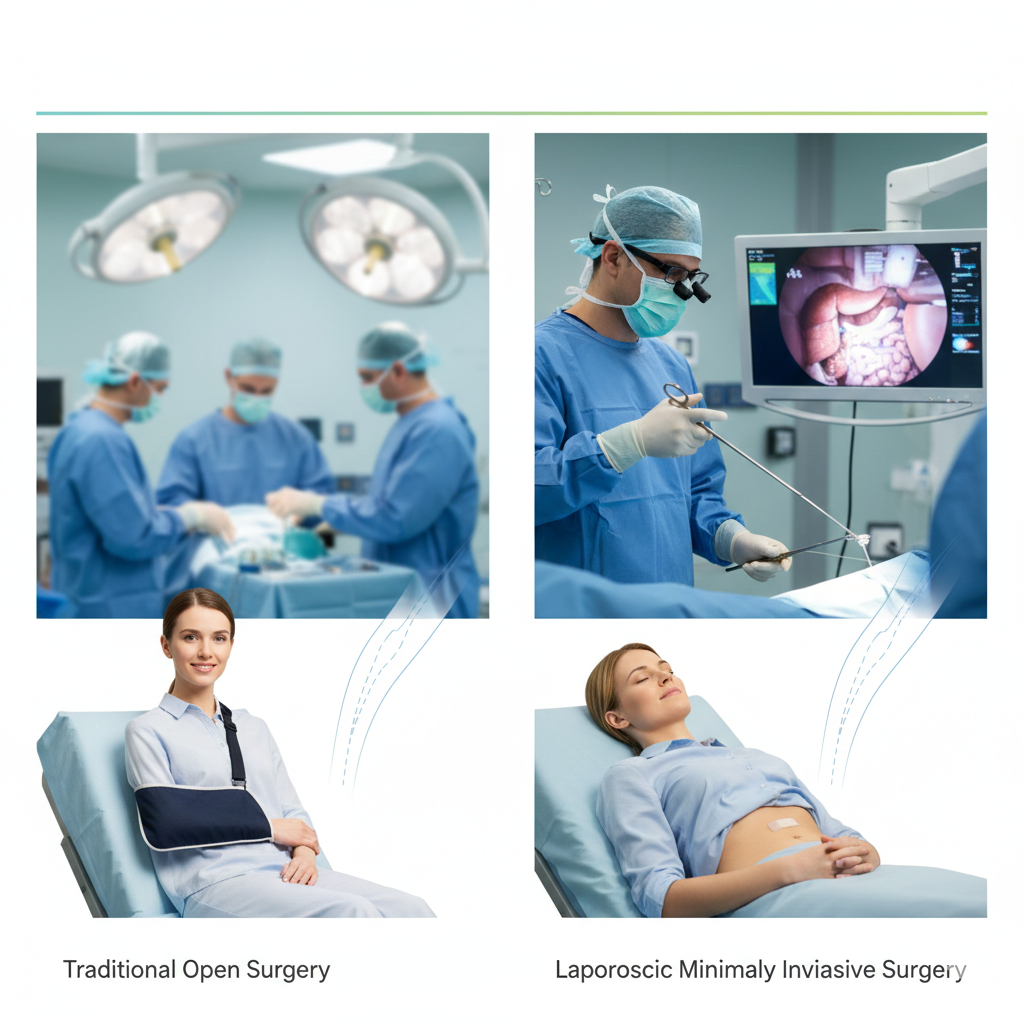
At Shivansh Women’s Hospital and Cosmetic Skin Clinic in Nikol, Ahmedabad, we specialize in moving beyond the “big scar” era of gynecology. Under the leadership of Dr. Saurabh Suthar, our facility has become a hub for Advanced Laparoscopy, specifically for treating uterine fibroids.
We recognize that for a modern woman, a surgery shouldn’t just be about removing a problem—it should be about how quickly and safely she can return to her life.
Shivansh Hospital is equipped with high-definition camera systems and precision instruments that allow us to perform “keyhole” surgeries with the same accuracy as traditional methods but with significantly less trauma to the body. Our commitment is to provide surgical excellence that preserves your health, your fertility, and your confidence.
1. Minimal Scarring and Aesthetic Preservation
One of the most immediate differences patients notice is the physical aftermath. Traditional open surgery (Laparotomy) requires a 5–7 inch horizontal or vertical incision. In contrast, laparoscopic fibroid removal (Myomectomy) uses tiny incisions, usually no larger than a buttonhole.
The Cosmetic Advantage
- Incision Size: We typically make 3 to 4 small incisions (5mm to 10mm) instead of one large, muscle-cutting opening.
- Healing Quality: These small spots often heal so well they become nearly invisible over time, unlike a prominent surgical scar.
- Tissue Trauma: Because we don’t pull back large layers of skin and muscle, there is significantly less “bruising” to the abdominal wall.
- Real Problem: Many women fear losing their confidence in certain clothes or at the beach. Example: It’s the difference between a “zipper” scar across your belly and a few small “freckles” that fade away—allowing you to heal without a permanent visual reminder of the surgery.
2. Significantly Reduced Recovery Time
For the working woman or the busy mother in Ahmedabad, time is the most valuable asset. Traditional surgery often keeps a patient in the hospital for 4–5 days and requires 6 weeks of home rest. Laparoscopy changes that timeline entirely.
Getting Back to Life
- Hospital Stay: Most of our laparoscopic patients go home within 24 to 48 hours.
- Return to Work: Most women can return to light office work within 10–14 days rather than a month and a half.
- Activity Levels: Walking and light movement are encouraged almost immediately after the anesthesia wears off.
- Real Problem: The “burden” of being dependent on family for weeks. Example: Think of it like a long-haul flight versus a quick commute; with laparoscopy, you land and get straight back to your routine instead of needing days to “recover” from the journey itself.
3. Less Post-Operative Pain and Medication
Because laparoscopic surgery is “minimally invasive,” the internal disturbance to the pelvic organs is minimized. This leads to a much more comfortable post-operative experience with less reliance on heavy painkillers.
Pain Management Benefits
- Internal Precision: Small instruments cause less friction and irritation to the surrounding intestines and bladder.
- Nerve Preservation: Smaller incisions mean fewer nerves are cut, reducing the sharp, stinging pain associated with large wounds.
- Reduced Inflammation: Less exposure of internal organs to the outside air reduces the inflammatory response of the body.
- Real Problem: The fear of “heavy” narcotics or addiction. Example: Most laparoscopic patients find that simple over-the-counter pain relief is enough after the first two days, whereas open surgery often requires intense clinical pain management for a week.
4. Lower Risk of Infections and Complications
Every large incision is a potential doorway for bacteria. By keeping the “door” nearly shut through keyhole surgery, we drastically lower the chances of hospital-acquired infections or wound complications.
Safety and Sterility
- Reduced Blood Loss: The high-definition camera allows us to seal blood vessels with extreme precision, leading to minimal blood loss.
- Wound Complications: Large incisions are prone to “dehiscence” (opening up) or hernias; small laparoscopic holes are extremely stable.
- Internal Adhesions: Laparoscopy results in fewer “internal scars” (adhesions) which can often cause pelvic pain or bowel issues years later.
- Real Problem: The “secondary” emergency after surgery. Example: It’s like fixing a leak through a small pipe versus tearing down the whole wall; the less you disturb the structure, the less likely you are to create a new problem while fixing the old one.
5. Enhanced Precision Through High-Definition Visualization
There is a common myth that “open” surgery allows the doctor to see better. In reality, the laparoscopic camera (Laparoscope) provides a magnified, high-definition view of the fibroids that the naked eye simply cannot match.
The Surgeon’s “Super-Vision”
- Magnification: We can see the tiny blood vessels and the exact border between the fibroid and the healthy uterine muscle.
- Deep Access: The camera can reach deep into the pelvis where a surgeon’s hands might struggle to see in an open procedure.
- Detailed Removal: This precision ensures we remove even the smallest “seed” fibroids that could grow later.
- Real Problem: Worrying that a fibroid will be “missed.” Example: It’s like trying to find a needle in a dark room with a flashlight (Open) versus using a 4K digital zoom lens (Laparoscopic); the digital precision wins every time.
6. Preservation of Fertility for Future Pregnancy
For women who still wish to conceive, preserving the integrity of the uterine wall is the highest priority. Laparoscopic myomectomy allows us to remove the fibroids and meticulously stitch the uterus back together to ensure it is strong enough for pregnancy.
Protecting Your Reproductive Future
- Targeted Removal: We only touch the areas affected by fibroids, leaving the rest of the uterus undisturbed.
- Stronger Suturing: Advanced laparoscopic suturing techniques ensure the uterine “seam” is robust.
- Less Scar Tissue: Fewer internal adhesions mean the fallopian tubes are less likely to get blocked after surgery.
- Real Problem: Fearing that a “fibroid surgery” means a “hysterectomy.” Example: At Shivansh Hospital, we treat the fibroid as a “weed” in a garden; our goal is to pull the weed out without disturbing the flowers (your uterus) or the soil (your fertility).